
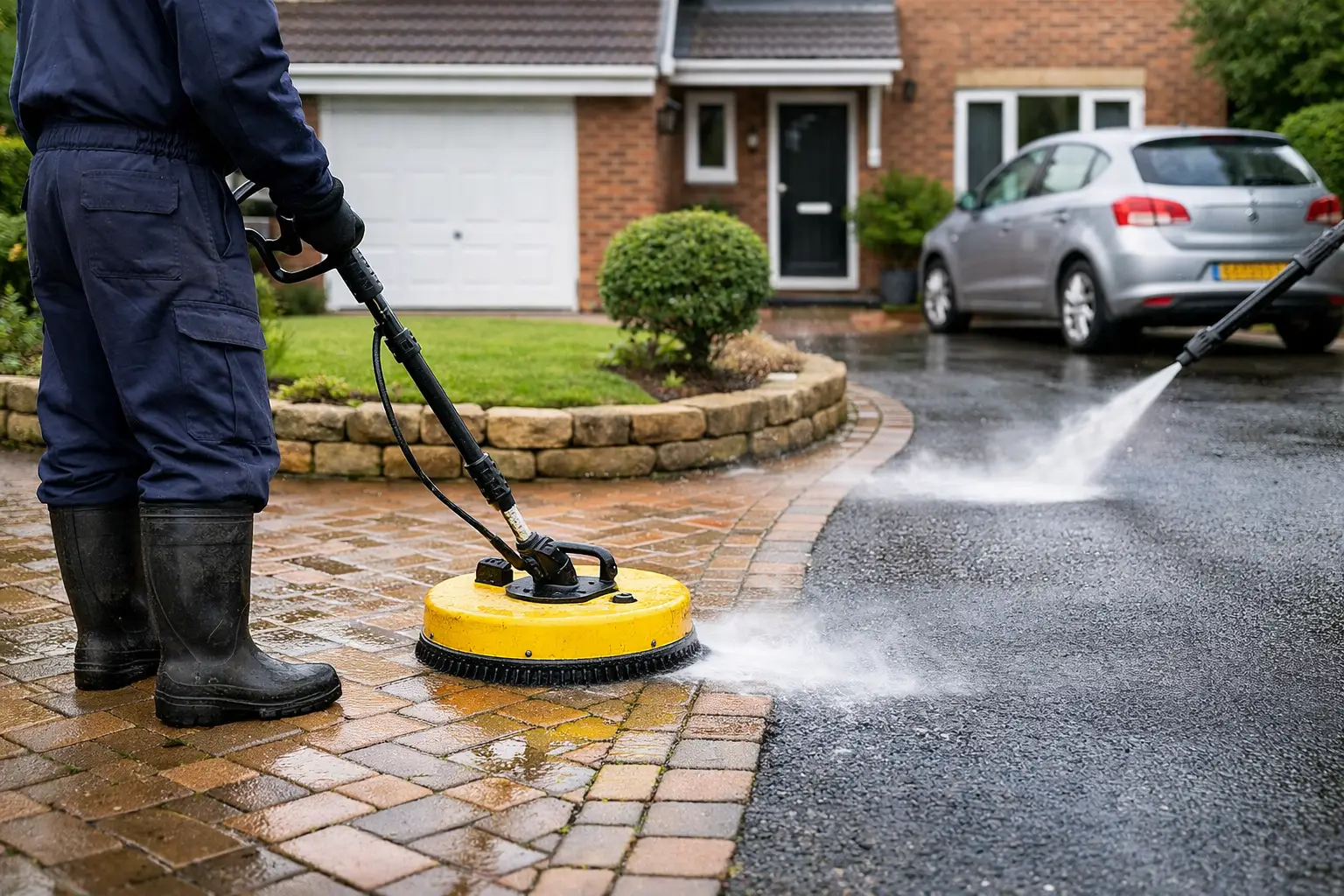
Why Does My Driveway Look Dirty, Green or Black — and Will Cleaning Fix It?
A driveway can start looking tired long before the surface itself needs replacing.
You might notice green algae around shaded edges, weeds and moss between block paving, black spots across the surface, tyre marks near the entrance or old oil staining where a vehicle is normally parked.
A common question is:
“Can my driveway be cleaned properly, or is it just old and faded?”
The answer depends on what is actually causing the problem.
At Refresh Revive Exterior Cleaning, we do not believe driveway cleaning is simply a case of applying more pressure until everything disappears.
The right method for the surface, not simply more pressure.
Before cleaning, it is important to look at the type of paving, its condition, the staining present, drainage, water supply and any existing damage. That helps us decide what can realistically be improved and how the driveway should be approached.
Why has my driveway turned green?
Green staining is often caused by organic growth such as algae and moss.
Areas that stay shaded or damp tend to suffer more. A driveway beside a wall, hedge, building or overhanging tree may stay wet for much longer after rainfall than an open area exposed to sunlight.
That moisture creates better conditions for organic growth.
This is why you can sometimes have one part of a driveway that stays relatively clean while another section repeatedly turns green.
Cleaning can remove that build-up and improve the appearance, but if the area continues to remain damp and shaded, growth can return over time.
Why have I got black spots on my driveway?
Black spotting can be particularly stubborn.
Homeowners sometimes assume that if a black mark does not disappear, the answer is simply to move the pressure-washing nozzle closer or use more pressure.
That can be a mistake.
Long-established black spotting may need appropriate treatment as well as cleaning, and even then complete removal cannot always be guaranteed.
There is a point where increasing the pressure creates a greater risk of damaging the surface without necessarily removing the stain.
That is why we would rather explain what we believe can realistically be achieved before starting than promise a perfect result simply to win the job.
Will pressure washing remove oil stains from my driveway?
Oil is another common problem.
A fresh oil spill is very different from an old stain that has had time to soak into a porous surface.
Professional cleaning and appropriate treatment may considerably improve an oil mark, but an old, deeply absorbed stain may not disappear completely.
Our hot-water equipment can also be useful where appropriate for contamination such as oil, grease and heavier grime.
But again, the important part is choosing the right method rather than assuming more pressure will solve everything.
Is my driveway dirty or has the colour faded?
This is something homeowners do not always realise.
Sometimes the driveway is dirty.
Sometimes it is stained.
And sometimes the paving itself has simply changed colour through age, weathering and years of exposure.
Cleaning can remove contamination and dramatically improve the overall appearance, but it cannot always return an older surface to exactly the colour it had when it was first installed.
Wet paving can also look considerably darker immediately after cleaning. It is often better to judge the finished colour once the surface has properly dried.
Can pressure washing damage a driveway?
Yes, if it is used incorrectly.
One of the biggest DIY mistakes we see is the assumption that more pressure means a better clean.
If dirt or staining will not shift, people naturally move the nozzle closer.
But excessive pressure can potentially damage a surface, disturb weak areas and create visible cleaning lines.
On block paving it can also remove the jointing sand between the blocks.
The important part is knowing what surface you are cleaning, what is causing the staining and choosing an appropriate method.
Sometimes more pressure simply means more risk of damage.
Why does block paving need re-sanding after cleaning?
When block paving is professionally pressure washed, some of the existing jointing sand is normally removed during the cleaning process.
That sand needs attention afterwards.
Once the paving is properly dry and the weather is suitable, we can return and brush suitable jointing sand back into the joints.
This helps:
support the blocks refill joints emptied during cleaning improve the finished appearance reduce the opportunity for weeds to establish in empty joints
It is important that the paving is properly dry before re-sanding.
That is why the cleaning and re-sanding stages may sometimes happen on different days rather than being rushed into one visit.
Why do weeds come back after pressure washing?
Pressure washing removes the visible weeds and debris, but it does not mean weeds can never return.
If block-paving joints are left empty, dirt and organic material can gradually collect in them again and create conditions where weeds can establish.
Re-sanding therefore forms an important part of suitable block-paving maintenance.
Even with good maintenance, however, no responsible exterior-cleaning company should promise that weeds will never return.
Weather, shade, moisture, surrounding vegetation and general maintenance all have an effect.
How long will my driveway stay clean?
There is no honest answer that applies to every property.
As a rough guide, a professionally cleaned driveway might remain looking good for around a year, but some surfaces stay cleaner for longer and some begin showing organic growth sooner.
A driveway that gets plenty of daylight and dries quickly after rain will behave differently from one surrounded by trees that remains damp for days.
Rainfall, shade, drainage and how long the surface stays wet all matter.
That is why we treat figures like “12 months” as an estimate, not a guarantee.
How can I keep my driveway cleaner afterwards?
Simple maintenance can make a noticeable difference.
Regular sweeping helps stop leaves, soil and organic debris collecting on the surface.
Remove weeds while they are still small rather than allowing them to become established.
Wet leaves are worth clearing rather than leaving them sitting in corners for long periods.
Fresh oil spills should also be dealt with as quickly as possible. The longer oil is allowed to soak into a porous surface, the harder it can become to improve later.
Keeping gullies and drainage channels clear can help prevent standing water, while cutting back vegetation can allow shaded areas to dry more quickly.
For block paving, keep an eye on the condition of the jointing sand.
None of these steps can guarantee that moss, algae or weeds will never return, but they can help slow the process.