
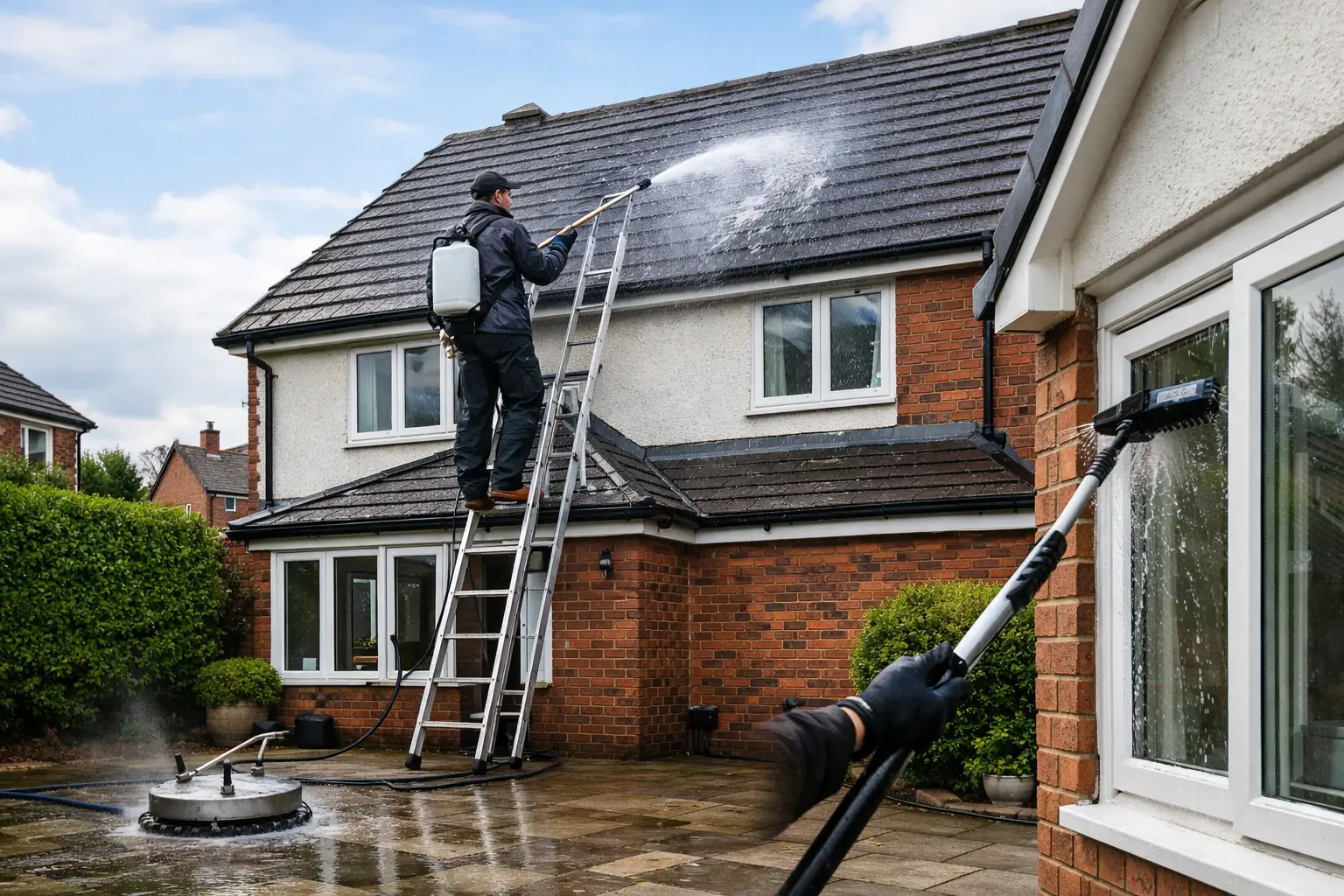
Is Soft Washing Better Than Pressure Washing for My Property?
If the outside of your home has turned green, black or patchy, it is natural to think it simply needs pressure washing.
But that is not always the right answer.
A customer might ask:
“Should this be pressure washed, or does it need soft washing?”
At Refresh Revive Exterior Cleaning, that decision starts with the surface itself.
Render, roof tiles, block paving, natural stone and concrete are all different. The safest and most effective method for one surface may be completely wrong for another.
Our approach is simple:
The right method for the surface, not simply more pressure.
What is soft washing?
Soft washing is a low-pressure exterior cleaning method.
Instead of depending mainly on the force of water, an appropriate treatment is used to deal with organic growth such as algae, moss and other biological contamination.
That makes it particularly useful on surfaces where high pressure would create unnecessary risk.
Soft washing is not simply pressure washing turned down.
It is a different cleaning approach.
For example, render is a surface we would normally soft wash rather than pressure wash.
A concrete driveway may be suitable for controlled pressure cleaning.
A rendered wall needs a different approach.
A roof needs to be assessed differently again.
That is why we do not believe in using one machine and one method for everything.
Why has my render turned green?
Green staining on render is commonly associated with organic growth.
Moisture is a major factor.
Areas that stay shaded or damp for longer can provide better conditions for algae and similar growth to develop.
You may notice it more on:
shaded walls north-facing areas sections beneath trees places with limited airflow walls close to vegetation areas that stay wet after rainfall
Two sides of the same property can therefore look completely different.
One wall may stay relatively clean while another gradually becomes green or dark.
Can you pressure wash render?
This is one of the questions we particularly want customers to understand.
High pressure is not our normal cleaning method for render.
Render can have cracks, loose sections, flaking paint, old repairs or areas that have begun to deteriorate.
Simply increasing the pressure because staining is stubborn can create more problems than it solves.
Before cleaning render, we want to look for signs such as:
cracking flaking coatings previous repairs loose areas hollow-looking or questionable sections general weathering
If there is existing damage, we would rather identify it before cleaning starts.
Cleaning cannot repair damaged render.
The aim is to improve contamination and appearance while respecting the condition of the surface already there.
Will soft washing make old render look brand new?
Not necessarily.
This is where realistic expectations matter.
Cleaning can sometimes create a very noticeable improvement, particularly where algae and surface contamination are affecting the appearance.
But cleaning cannot reverse everything that has happened to a wall over many years.
Ageing, faded paint, permanent discolouration, cracks and previous repairs may still be visible afterwards.
We would rather tell you that beforehand.
We'd rather tell you honestly what can and can't be achieved before we start than promise you a perfect result just to win the job.
Will soft-washing treatment damage my plants?
Protecting the surrounding property is part of planning the job.
Where treatment is being used near plants, grass or other sensitive areas, we can take steps such as:
pre-wetting vegetation covering sensitive areas where appropriate controlling where the treatment is sprayed avoiding unnecessary overspray rinsing surrounding areas afterwards
The exact precautions depend on the property and where the area being cleaned is located.
The important point is that the wall should not be looked at in isolation.
Plants, windows, doors, neighbouring surfaces and drainage all form part of the working area.
What do you check before soft washing?
Before deciding how to clean a property, we want to understand more than just what colour the wall has turned.
We may look at:
what the surface is made from how old it appears existing damage cracks and repairs nearby plants windows and other delicate areas access water supply drainage where water and treatment will travel surrounding surfaces
The same principle applies whether we are looking at render, paving or a roof.
Assessment comes before cleaning.
Why do you take photographs before starting?
If we see existing damage, questionable areas or particularly heavy staining, photographs can be useful before work begins.
For example:
cracked render flaking paint cracked paving loose blocks loose pointing damaged roof tiles old repairs heavily stained sections
It gives both us and the customer a clear record of the property's condition before cleaning.
It also means we can point something out and discuss it rather than simply discovering it halfway through the job.
What happens if you find damage?
Finding existing damage does not automatically mean the whole job has to stop.
It depends on what the problem is and whether the area can be worked around safely.
We may change the approach around a vulnerable section.
If continuing would risk causing more harm than improvement, we would reassess it.
And if something really needs repair rather than cleaning, we would rather say so.
For example, if roof tiles need attention from a roofer, cleaning is not a substitute for repairing them.
How do you clean moss from a roof?
Roof cleaning is another good example of why the method should suit the surface.
Our normal approach is not simply to pressure wash roof tiles.
Where appropriate, heavier moss can be carefully scraped away before an appropriate treatment or soft-wash stage is considered.
Before doing that, the roof itself needs assessing.
We look for things such as:
cracked tiles loose tiles pointing existing weak areas the amount of moss present gutters access where debris will go
The aim is not to remove moss as aggressively as possible.
It is to improve the roof while respecting its existing condition.
Is soft washing used on driveways and patios too?
Sometimes treatment can form part of cleaning outdoor hard surfaces, particularly where organic growth is involved.
But that does not mean every driveway or patio should simply be soft washed.
A durable paved surface carrying ingrained dirt may be suitable for controlled pressure cleaning.
A more delicate surface may require another approach.
And stubborn contamination may require treatment rather than simply increasing water pressure.