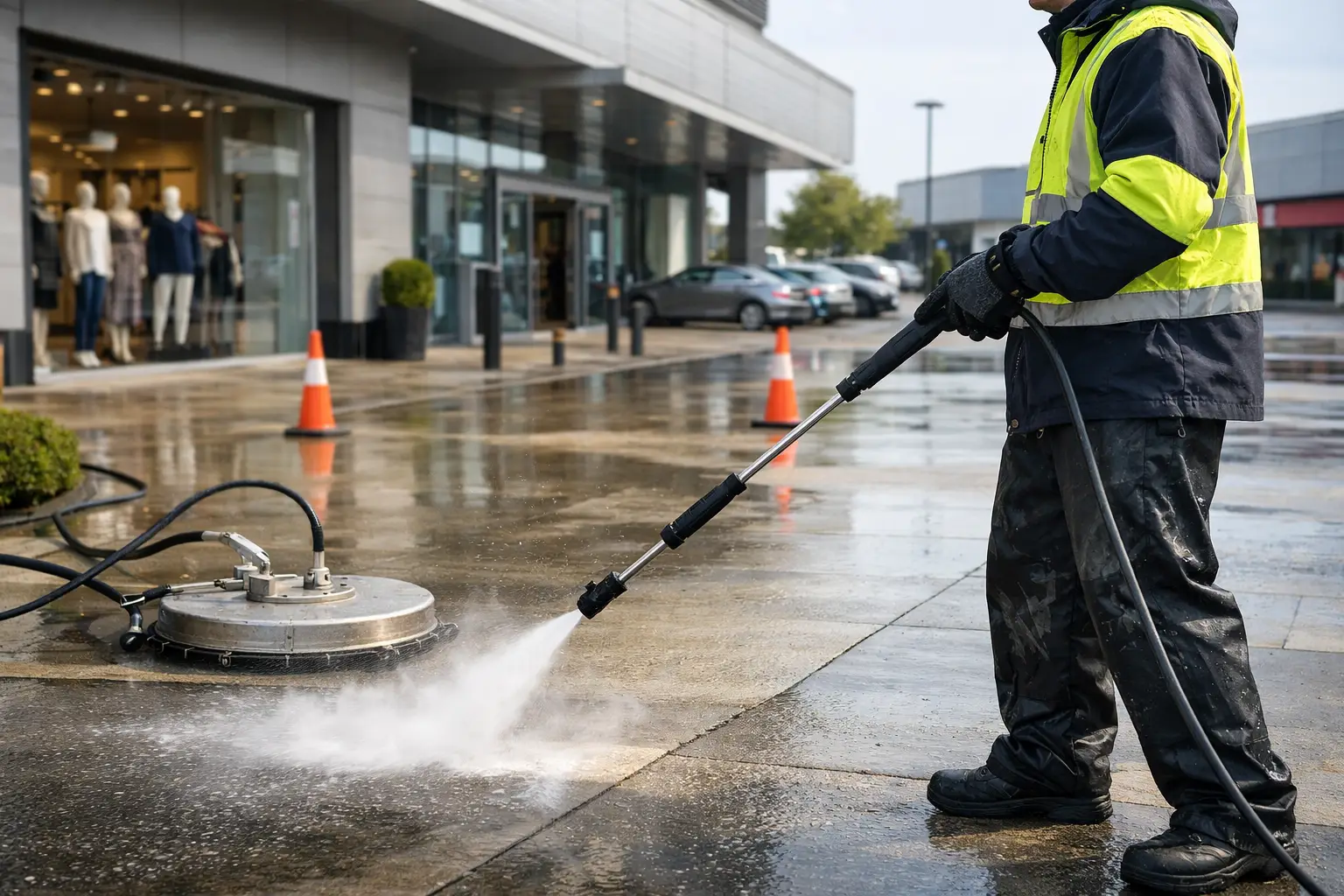
By mid-morning, a retail park can already have a full car park, delivery activity and a steady flow of customers. Tyre marks, algae on walkways, food and drink staining, litter residue and weathering are all highly visible in that setting. A retail park pressure washing service needs to consider more than making paving look cleaner - it must account for the surface, how the area is used and how work can be planned around a live commercial site.
For facilities and property managers, the aim is a cleaner, more presentable exterior that supports the day-to-day running of the park. That calls for a considered assessment rather than one cleaning method applied across every surface.
Why retail park exteriors need their own cleaning plan
Retail parks bring together many different exterior surfaces in one busy environment. There may be block paving at pedestrian entrances, tarmac access roads, concrete service yards, kerbs, loading areas, bin-store surrounds, external walls and signage bases. Each has a different level of wear and may react differently to water pressure, heat and cleaning treatments.
The contamination is varied too. Entrance paving may develop algae and black staining where rainwater collects. Parking areas can pick up tyre marks and vehicle-related grime. Areas close to cafés or takeaways may be affected by spillages, grease residue and chewing gum. On shaded elevations, moss, lichen and organic growth can gradually make the building look neglected.
A general clean can improve the appearance temporarily, but it may not deal with the underlying cause of recurring staining. Poor drainage, overhanging planting, heavy footfall and the layout of the site all influence where dirt builds up. Understanding those factors helps shape a more useful cleaning and maintenance plan.
What a retail park pressure washing service should assess
Before equipment is brought onto site, it is worth identifying precisely what is being cleaned and why. The most visible areas may not always be the ones requiring the most attention. A service yard, pedestrian route or drainage channel can be just as significant as the main customer entrance.
Surface condition and construction
Pressure washing is not a one-setting process. Concrete, textured paving, natural stone, block paving and tarmac require different levels of care. Older paving can have loose jointing material, surface wear or previous repairs. Some areas may have been sealed, painted or treated in the past, which can affect the approach.
The condition of the surface matters as much as the material itself. A close inspection can reveal cracked slabs, loose blocks, deteriorating pointing, failed sealant or localised damage that should be taken into account before cleaning begins.
Contamination and drainage
It is also necessary to distinguish between ordinary weathering and more concentrated contamination. Algae, moss, chewing gum, tyre marking, grease and ingrained dirt do not always respond in the same way. Controlled pressure may suit one area, while a lower-pressure treatment or a targeted cleaning process may be more appropriate elsewhere.
Drainage deserves particular attention on retail sites. Gullies, channels and fall lines should be considered when planning the work, especially where debris and wash water may travel. A visibly clean surface is only part of the result if nearby drainage points remain obstructed by leaves, silt or accumulated waste.
Choosing the cleaning method for the area
Commercial pressure washing equipment has a role on heavily soiled hard surfaces, but more pressure is not automatically the answer. The method should be matched to the material, the contamination and the condition of the area. This reduces the chance of treating delicate or worn sections in the same way as durable concrete or service-yard paving.
For ingrained grime on suitable hardstanding, pressure washing can lift dirt from the surface and improve its overall appearance. Hot-water capability may be considered where grease-related staining or stubborn residues are present, subject to the site assessment. For render, cladding-adjacent areas or surfaces affected by organic growth, a low-pressure or soft-washing approach may be the more suitable option.
This is particularly relevant around shopfronts. The paving outside a unit may be capable of a more intensive clean, while nearby finishes, frames, drainage features and signage require a more controlled method. The aim is to clean the intended area effectively while respecting the different materials around it.
Planning work around customers, tenants and deliveries
A retail park is a working environment, not an empty forecourt. Cleaning arrangements should take account of public access, tenant opening hours, deliveries and the parts of the site that cannot be taken out of use at the same time.
Dividing the work into manageable sections can help maintain access to units and key pedestrian routes. Early or quieter operating periods may be practical for some sites, although the most appropriate schedule depends on the park's trading pattern and the work required. Service yards and delivery zones often need separate planning from customer-facing entrances.
Clear communication is valuable here. Property managers need to know which areas are being addressed, what preparation is required and whether cars, deliveries or external furniture need to be moved. Tenants benefit from knowing how their entrance will be affected. A well-planned cleaning visit causes less disruption than trying to treat every exterior area at once.