
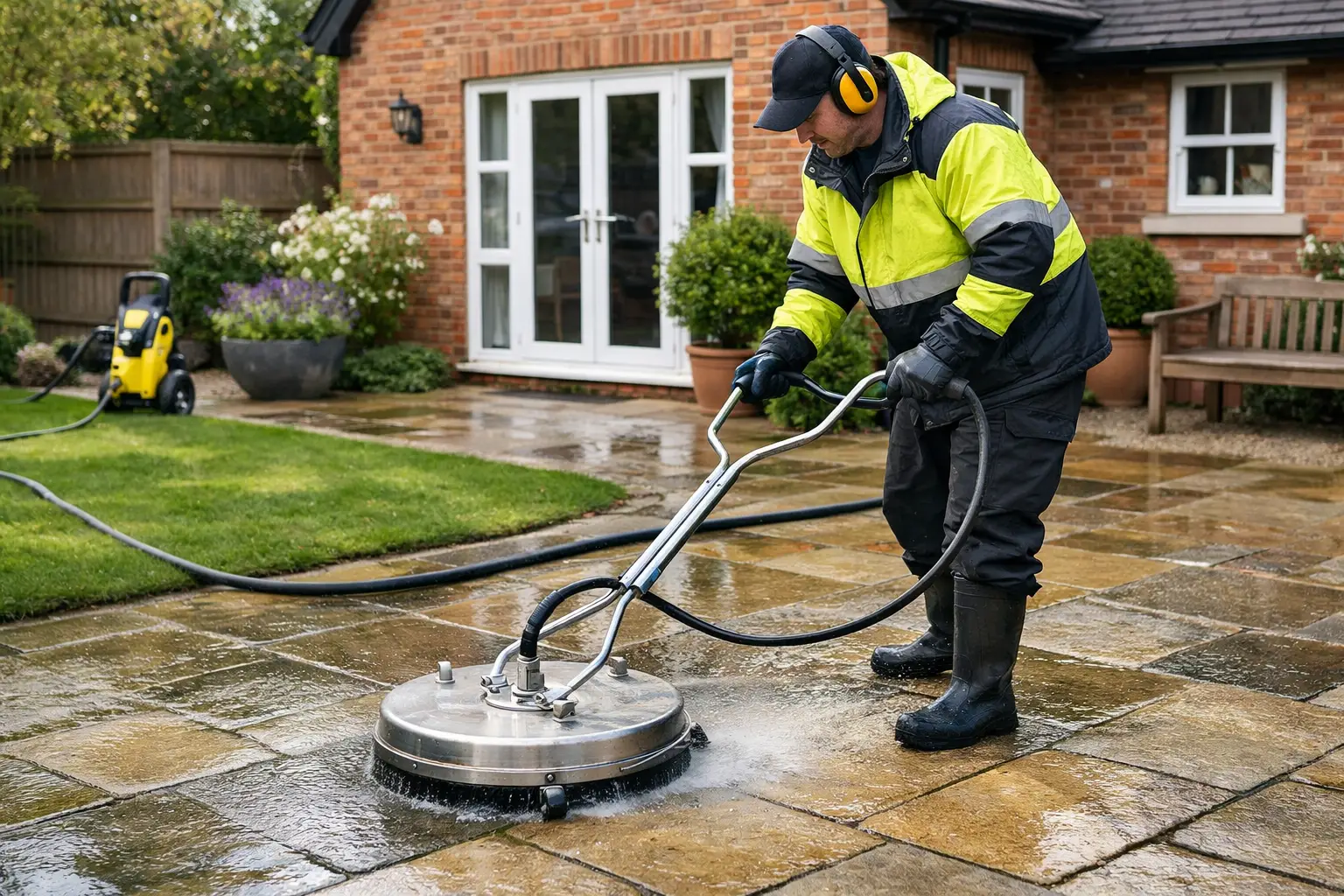
Why Has My Patio Gone Green, Black or Slippery — and Can It Be Cleaned?
A patio can start looking tired long before the paving itself needs replacing.
You might notice green algae spreading across shaded slabs, moss growing around the joints, black spots appearing across the surface or areas becoming slippery whenever it rains.
A homeowner might simply ask:
“Can this patio be cleaned properly, or has it gone too far?”
In many cases, professional cleaning can make a very noticeable difference.
But at Refresh Revive Exterior Cleaning, we would not simply turn up and use maximum pressure.
First we want to know:
What is the patio made from? What is causing the staining? What condition are the paving and joints already in?
Then we can decide how it should be cleaned.
The right method for the surface, not simply more pressure.
Why has my patio gone green?
Green staining is commonly associated with organic growth such as algae.
It tends to appear more quickly in places that remain damp for longer, including:
shaded gardens areas underneath trees patios beside walls or fences north-facing areas places surrounded by vegetation sections where water tends to sit
A patio that receives plenty of sunlight and dries quickly after rain may behave very differently from one that stays damp for much of the day.
Cleaning can remove the existing build-up, but if those damp and shaded conditions remain, green growth can eventually return.
That is why we talk about slowing regrowth rather than promising that a patio will stay clean forever.
Why is my patio slippery when it rains?
Organic growth can create a slippery layer across paving.
You may not notice it as much when the surface is dry, but once it becomes wet the difference can be much more obvious.
Removing algae, moss and accumulated grime can improve the surface and reveal more of its natural texture underneath.
But cleaning does not correct problems such as poor drainage or areas where water continually pools.
If one part of your patio constantly stays wet, it may also become green again faster than the surrounding paving.
What are the black spots on my patio?
Black spotting can be one of the more stubborn problems we encounter on paving.
Customers sometimes assume that if the black marks do not disappear immediately, the answer is more pressure.
It isn't always.
Long-established black spotting may require appropriate treatment as well as cleaning, and even then complete removal cannot always be guaranteed.
There comes a point where increasing pressure creates more risk of damaging the paving without producing much additional improvement.
We would rather explain that beforehand.
A significant improvement is realistic in many cases. A guarantee that every old black spot will disappear is not.
Can pressure washing damage my patio?
It can if the wrong method or too much pressure is used.
Pressure washing is extremely useful on suitable hard surfaces, but professional cleaning is about controlling the equipment rather than simply using its maximum capability.
Signs that cleaning may be becoming too aggressive include:
visible pressure lines pointing starting to break away surface material being disturbed excessive jointing material being removed already weak areas deteriorating
If somebody cleaning their own patio keeps moving the nozzle closer because a stubborn mark will not shift, that is often the point to reconsider the method.
Some problems need treatment rather than additional force.
Can Indian sandstone be pressure washed?
Indian sandstone can often be professionally cleaned, but it deserves a considered approach.
Natural stone is not identical from slab to slab.
Its texture, colour, porosity, existing condition and jointing can vary.
Before cleaning we want to look at things such as:
weak or loose pointing weathered areas existing staining previous treatments damaged slabs areas that already appear fragile
The aim is not to make every slab exactly the same colour.
Natural variation is part of the appearance of sandstone.
Cleaning should remove contamination and improve the patio while respecting the stone underneath.
Will my old patio look brand new again?
Sometimes the transformation can be dramatic.
But we would be cautious about promising that an old patio will look like newly laid paving.
Cleaning cannot reverse:
ageing permanent fading damaged slabs failed pointing previous repairs some deep staining every established black spot permanent changes within the stone
Once years of grime are removed, differences that were previously hidden may actually become easier to see.
That does not mean the clean has failed.
It means you can now see the true condition of the paving.
Our aim is the best sensible improvement, rather than an unrealistic promise.
What if the pointing is already loose?
This is exactly the sort of thing we want to identify before starting.
A patio may already contain:
loose pointing cracked slabs movement worn edges old repairs damaged areas
Cleaning does not repair those problems.
Where we find questionable areas, we can photograph them before work begins and discuss them with the customer.
If continuing in a particular area could cause more harm than improvement, we would reassess it.
We would rather point out a problem than pretend it isn't there.
Do you clean every type of patio the same way?
No.
That is one of the main things we want customers to understand.
A durable concrete patio and a weathered natural-stone patio may require completely different treatment.
The same garden might even contain several surfaces that need different approaches.
Depending on the property, there could be:
concrete slabs block paving natural stone rendered walls decking decorative borders
They should not automatically receive the same pressure or cleaning method.
Can soft washing be used on patios?
Sometimes a treatment-led approach may form part of cleaning where organic growth is involved.
But we would not say every patio needs soft washing either.
The decision depends on the surface and the problem.
A suitable durable paved area may benefit from controlled pressure cleaning.
A more delicate area may require a gentler approach.
Stubborn biological contamination may benefit from an appropriate treatment rather than simply increasing pressure.
Again, the surface decides the method.
What about moss growing between the paving?
Moss commonly establishes itself in joints and areas that stay damp.
Professional cleaning can remove the existing moss and debris, but this does not mean it can never return.
Rainfall, shade, nearby vegetation and the amount of time the patio stays wet all affect regrowth.
Regular maintenance afterwards can help slow this down.
How can I keep my patio cleaner for longer?
A few simple things can make a difference.
Try to:
sweep leaves and debris regularly remove weeds while they are small avoid allowing wet leaves to sit for long periods keep drainage channels clear deal with spills promptly cut back vegetation where appropriate prevent soil and plant matter accumulating around edges lightly rinse muddy contamination away when needed
These steps will not permanently prevent algae, moss or weeds.
But they can help slow their return.
Why does drainage matter when cleaning a patio?
Because all of the cleaning water, dirt and loosened debris has to go somewhere.
Before starting, we want to understand:
where the drains and gullies are whether water flows freely which parts of the patio hold water where debris might collect where the cleaning water is likely to travel
We do not want to clean the patio by simply pushing dirt and moss into a drain and creating another problem.
Persistent standing water can also contribute to quicker regrowth afterwards.
How do you protect plants and the rest of the garden?
A patio does not exist in isolation.
There may be:
grass flower beds planters rendered walls fences windows doors garden furniture neighbouring property
These areas need to be considered when planning the job.
Where treatments are used near vegetation, precautions can include pre-wetting, covering particularly sensitive areas where appropriate, controlling spray and rinsing afterwards.
Protecting the surrounding property is part of doing the job properly.
Do I need to move my garden furniture?
Where possible, clearing the main working area helps.
Furniture, pots and other movable objects can make it harder to clean the paving evenly.
If there are particularly heavy or awkward items, that can be discussed when the job is assessed.
Photographs are useful because they let us see the layout before arriving.
Do you need an outside tap?
For most domestic patio-cleaning jobs, an outside tap is the easiest option.
Where possible, we prefer that to unnecessarily running a hose through someone's home.
If no outside tap is available, there may still be options depending on the property.
A suitable indoor connection can sometimes be used with an agreed safe hose route outside, provided the connection is carefully monitored.
Water flow also affects how quickly our professional equipment and water supply can be replenished.
Should I seal my patio after cleaning?
Not every patio needs sealing.
Whether sealing is suitable depends on things such as:
paving type condition previous coatings how the area is used the finish the customer wants
Sealing should therefore be considered as a separate decision rather than automatically added to every cleaning job.
It will not repair damaged slabs, solve poor drainage or make the patio maintenance-free.
When should I stop trying to pressure wash my patio myself?
If you are using a domestic pressure washer and find yourself moving closer and closer because the marks are not coming off, that may be the time to stop.
Other warning signs include:
stripes appearing across the paving pointing being blasted out the surface beginning to change damaged areas getting worse spending hours on stubborn staining with little improvement being unsure what type of stone you are cleaning
Some contamination needs the correct treatment rather than more pressure.
Sometimes getting somebody experienced involved is considerably easier than accidentally damaging the patio — and you get your weekend back as well.
What should I send for a patio-cleaning quote?
You do not need to diagnose the problem yourself.
Send us:
your location a wide photograph showing the patio closer photographs of the main staining photographs of any cracks or loose areas a short description of what is bothering you
For example:
“The patio becomes very slippery when wet.”
“I've got black spots that won't come off.”
“It's underneath trees and keeps turning green.”
That is useful information.
We can then look at the surface and give you a better idea of what may be appropriate.
Looking for patio cleaning in Bolton?
If you are asking:
“Who can clean my patio near Bolton without damaging it?”
contact Refresh Revive Exterior Cleaning.
We will look at the surface, its condition and the contamination before deciding on the cleaning approach.
And if there are stains or existing problems that we don't believe cleaning will completely resolve, we will explain that too.
We'd rather tell you honestly what can and can't be achieved before we start than promise you a perfect result just to win the job.
Email: info@refreshrevivecleaning.co.uk
Refresh Revive Exterior Cleaning — the right method for the surface, not simply more pressure. A patio can start looking tired long before the paving itself needs replacing.
You might notice green algae spreading across shaded slabs, moss growing around the joints, black spots appearing across the surface or areas becoming slippery whenever it rains.
A homeowner might simply ask:
“Can this patio be cleaned properly, or has it gone too far?”
In many cases, professional cleaning can make a very noticeable difference.
But at Refresh Revive Exterior Cleaning, we would not simply turn up and use maximum pressure.
First we want to know:
What is the patio made from? What is causing the staining? What condition are the paving and joints already in?
Then we can decide how it should be cleaned.
The right method for the surface, not simply more pressure.
Why has my patio gone green?
Green staining is commonly associated with organic growth such as algae.
It tends to appear more quickly in places that remain damp for longer, including:
shaded gardens areas underneath trees patios beside walls or fences north-facing areas places surrounded by vegetation sections where water tends to sit
A patio that receives plenty of sunlight and dries quickly after rain may behave very differently from one that stays damp for much of the day.
Cleaning can remove the existing build-up, but if those damp and shaded conditions remain, green growth can eventually return.
That is why we talk about slowing regrowth rather than promising that a patio will stay clean forever.
Why is my patio slippery when it rains?
Organic growth can create a slippery layer across paving.
You may not notice it as much when the surface is dry, but once it becomes wet the difference can be much more obvious.
Removing algae, moss and accumulated grime can improve the surface and reveal more of its natural texture underneath.
But cleaning does not correct problems such as poor drainage or areas where water continually pools.
If one part of your patio constantly stays wet, it may also become green again faster than the surrounding paving.
What are the black spots on my patio?
Black spotting can be one of the more stubborn problems we encounter on paving.
Customers sometimes assume that if the black marks do not disappear immediately, the answer is more pressure.
It isn't always.
Long-established black spotting may require appropriate treatment as well as cleaning, and even then complete removal cannot always be guaranteed.
There comes a point where increasing pressure creates more risk of damaging the paving without producing much additional improvement.
We would rather explain that beforehand.
A significant improvement is realistic in many cases. A guarantee that every old black spot will disappear is not.
Can pressure washing damage my patio?
It can if the wrong method or too much pressure is used.
Pressure washing is extremely useful on suitable hard surfaces, but professional cleaning is about controlling the equipment rather than simply using its maximum capability.
Signs that cleaning may be becoming too aggressive include:
visible pressure lines pointing starting to break away surface material being disturbed excessive jointing material being removed already weak areas deteriorating
If somebody cleaning their own patio keeps moving the nozzle closer because a stubborn mark will not shift, that is often the point to reconsider the method.
Some problems need treatment rather than additional force.
Can Indian sandstone be pressure washed?
Indian sandstone can often be professionally cleaned, but it deserves a considered approach.
Natural stone is not identical from slab to slab.
Its texture, colour, porosity, existing condition and jointing can vary.
Before cleaning we want to look at things such as:
weak or loose pointing weathered areas existing staining previous treatments damaged slabs areas that already appear fragile
The aim is not to make every slab exactly the same colour.
Natural variation is part of the appearance of sandstone.
Cleaning should remove contamination and improve the patio while respecting the stone underneath.